 Iceland Volcano Tour
Iceland Volcano Tour Season: What Is Open, Month by Month
The Iceland volcano tour season splits the year in two. For about 25 weeks, from 5 May to 30 October, everything on this site is bookable, including the descent into Thrihnukagigur and the highland days to Askja and Landmannalaugar. Outside that window the F-roads are shut by snow and the chamber is closed, and what is left is the Reykjanes hikes, the lava tube, the ice caves and the indoor shows, all of which run all year. This page sets out what opens when, and which month suits which kind of volcano day. The full list is on Iceland volcano tour.
Quick answer Which season opens which volcano
For about 25 weeks a year, 5 May to 30 October, every kind of volcano tour in Iceland is open at once. Prices for the four tours compared here run from $72 to $480. No eruption is flowing right now.
Key takeaways
- Compare all four volcano tours on this page side by side with current prices.
- Year-round options are the Reykjanes eruption-site hikes, the Raufarholshellir lava tunnel and the indoor lava shows.
- Summer only: the Thrihnukagigur magma chamber descent and the Askja caldera day tour.
- Check what to wear on a volcano hike before you book any season.
Best Time for a Volcano Tour in Iceland: The Four Tours Compared
Each of these tours covers a different volcano and a different season, and none of them promises flowing lava. The Thrihnukagigur day trip is the only one that takes you inside a volcano, through an emptied magma chamber, and it runs from 5 May to 30 October. The Askja super jeep tour reaches a remote highland caldera and is summer only, because the F-roads close under snow the rest of the year. The Katla ice cave tour puts you on an ice-capped volcano in winter conditions, and the route inside the natural cave changes through the season. The Raufarholshellir lava tunnel is the cheapest and the only one open every month of the year. Figures current in Q3 2026.
 from $441
Inside the volcano
from $441
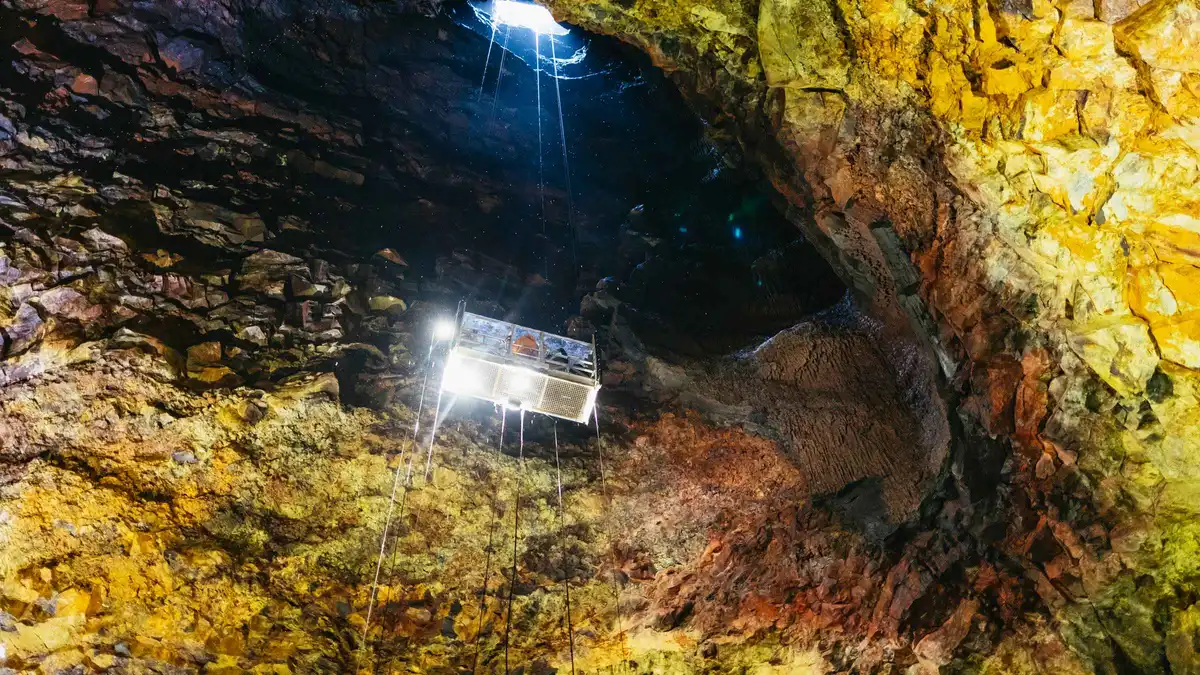
Inside the volcano Reykjavik: Thrihnukagigur Volcano Guided Hiking Day Trip
The only place on earth where you ride into an emptied magma chamber. Booked direct with the concession holder rather than resold, and 91% of English-speaking reviewers give it five stars. The hike from the cabin takes 45 to 50 minutes each way.
- 120-metre descent by lift into the magma chamber
- 45-50 minute hike across the lava field each way
- Up to an hour inside the chamber
- Soup at base camp after the descent
 from $480
Highland caldera
from $480
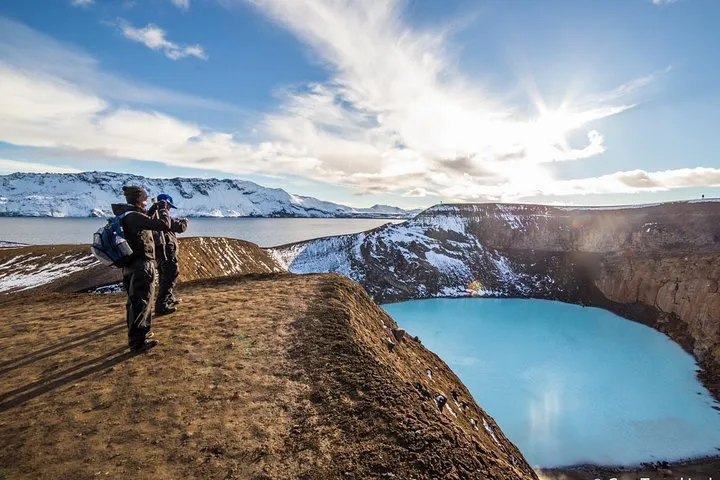
Highland caldera Askja and Holuhraun Super Jeep Day Tour from Lake Myvatn
The longest and most remote day on this list, and the only one that reaches a caldera you cannot drive to in a normal car. Bring your own food: there is no shop or restaurant anywhere on the route.
- Askja caldera and the Viti explosion crater
- Holuhraun, Iceland's largest lava field since 1783
- National park fees included
- Ten people maximum per booking
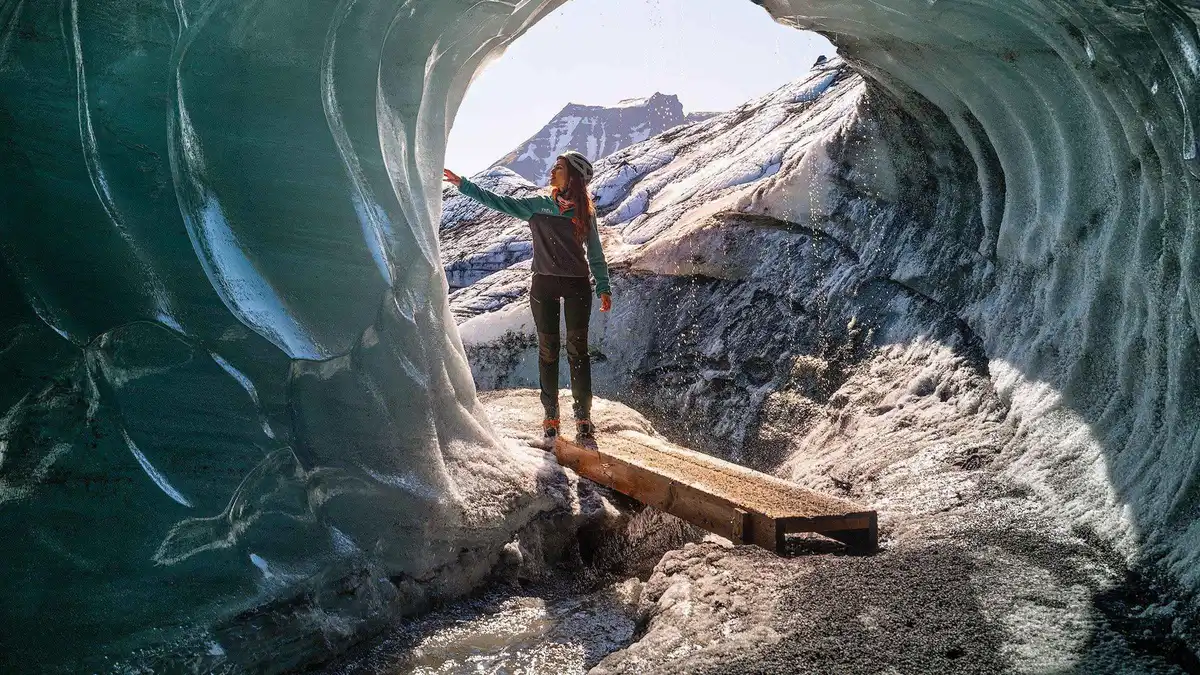
From Vik: Katla Ice Cave and Super Jeep Tour
The ice cave is inside the glacier that covers Katla, so this is the one tour on the list where you stand on an active volcano without seeing any lava. Crampons and helmets are provided and coffee waits in the jeep afterwards.
- Cancellation
- Free cancellation 24h
- Operator
- Troll Expeditions
 from $72
Cheapest lava
from $72
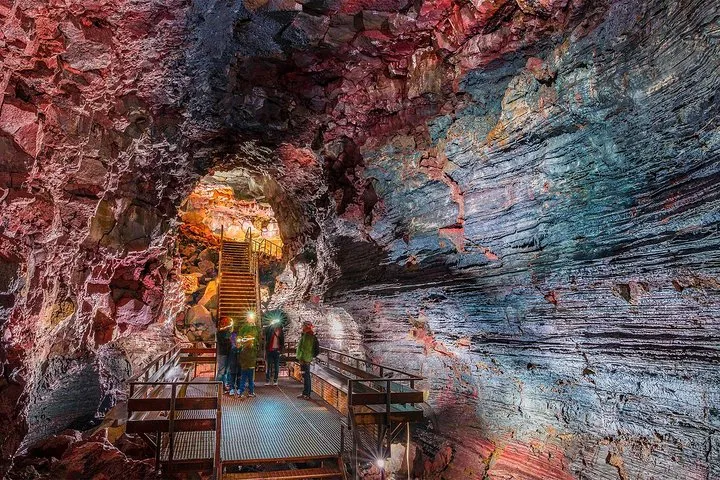
Cheapest lava The Lava Tunnel Tour, Raufarholshellir
The lowest price on this page and the only volcano interior open all year. You drive yourself: the ticket covers the guide, helmet and lights, not transport from the city.
- Walkway through a 5,200-year-old lava tube
- Helmet and lights included
- Open year-round, 30 minutes from Reykjavik
- Six departure times a day
Price, Duration and Season at a Glance
The table below compares the tours on this page by what you actually get, how long it lasts, where it starts and what it costs. Prices and durations come from the operator listings, and the season column reflects the restrictions each operator states.
| Tour | What you get | Time | Book | Leaves from | Price |
|---|---|---|---|---|---|
| Thrihnukagigur descent | 120-metre lift into a magma chamber | 4 hours | Check Availability | Breidabliksskali, Blafjoll | $441 |
| Askja and Holuhraun | Caldera, Viti crater, Holuhraun lava field | 12 hours | Check Availability | Lake Myvatn | $480 |
| Katla ice cave | Super jeep onto Myrdalsjokull, natural ice cave | 3 hours | Details | Vik | $274 |
| Raufarholshellir | Walkway through a 5,200-year-old lava tube | 1 hour | Check Availability | Self-drive, road 39 | $72 |
Can You See Flowing Lava in Iceland Right Now?
The short answer is no, and any page that tells you otherwise is selling you a photograph.
The Honest Status
No eruption is flowing as things stand. That matters more than any month on the calendar, because the eruption-site hikes on the Reykjanes peninsula sell a walk across cooled lava, not a look at fountains. The Icelandic Met Office reports continued uplift at Svartsengi. The land there has risen about five centimetres over the past three months, and while uplift continues the most likely scenario stays a magma intrusion propagating from Svartsengi into the Sundhnukur crater row. Uplift is not an eruption, and nobody can give you a date for one.
The helicopter operator's own listing describes an area with 12 eruptions in the last 4 years, about 30 km from Reykjavik, which tells you how fast this corner of Iceland has been moving. It does not tell you what you will see on the day you arrive. Book any Reykjanes walk knowing the trail, and whether it opens at all, is decided by the Department of Civil Protection and Emergency Management, not by the operator.
Is There a Prediction for 2026?
There is no prediction. Iceland's volcanologists can measure uplift, track magma intrusions and state which scenario is most likely, which is exactly what the Met Office has done for Svartsengi. What they cannot do is give a month. Askja is a different case. Measurements by the lake in Askja show that the uplift episode which began in 2021 has ended, so that system looks quieter today than Reykjanes does.
What this means for timing is simple. If seeing fresh lava matters more to you than anything else, no month is better than another, because no operator can promise it. What you can promise yourself is one of the four experiences on this page: a chamber descent, a caldera hike, an ice cave under a glacier, or a lava tube. The indoor lava shows are the only way to watch molten rock on demand, and they run all year. Read more in the guide to safety during an eruption.
What the Eruption-Site Hikes Do Sell
The Fagradalsfjall volcano tours and the wider Reykjanes options walk ground that erupted within the last four years. You cross black lava, see new craters and smell sulphur on some days. Guides explain the sequence of eruptions and point out where the fountains stood. That is a real experience and it runs in every season, though winter adds wind, ice and short daylight.
Two warnings belong here. First, volcanic gas is the reason trails close on days when the wind pushes it over the route, so a closure can happen on the morning of your tour. Second, ICE-SAR's Safetravel service warns that conditions on the Fimmvorduhals hiking trail are dangerous and advises people not to hike it while they stay that way. That is a separate trail from the Reykjanes sites, but it shows how quickly Icelandic hiking advice can change. Check Safetravel before any self-guided walk.
Sources: Icelandic Met Office and Safetravel
Month by Month: What Is Actually Open
The calendar on this page is dictated by roads, ice and a single season date, not by volcano activity.
The Two Fixed Seasons
Almost everything on this page falls into one of two groups. Inside the Volcano runs from 5 May to 30 October and not outside it, so the Thrihnukagigur magma chamber descent simply does not exist in an Icelandic winter. The highland F-roads to Askja and Landmannalaugar are shut by snow for most of the year, which is why the Askja day tour from Lake Myvatn is summer only. There is no workaround, no winter version and no early-season exception.
Everything else runs all year. The Reykjanes hikes, the Raufarholshellir lava tunnel and the indoor lava shows operate in every month. The Katla ice cave tour sits between the two groups. It runs in a broad season, but the ice caves are natural and the route inside changes through the season, so the cave you photograph in one month is not the cave a friend saw in another. The table below puts the four compared tours on one timeline so you can see the overlap.
Season Table for the Four Tours
This table is the core of the page. It answers the only question that matters about timing for each of the four tours compared here, using the operator's own stated availability. Note that Raufarholshellir is the only option with fixed daily departures all year, listed as six departure times a day, while the Askja tour depends on highland roads that close with the first serious snow.
| Tour | Season | Why it closes | Daily departures |
|---|---|---|---|
| Thrihnukagigur descent | 5 May to 30 October | Operator season only | Not stated |
| Askja and Holuhraun | Summer only | F-roads shut by snow | Not stated |
| Katla ice cave | Broad season, route varies | Natural cave changes through the season | Not stated |
| Raufarholshellir tunnel | Open year-round | Nothing, it is indoors | Six times a day |
Choosing a Month Within the Open Seasons
Within the summer window, the choice comes down to crowds and daylight rather than availability. May and October are the shoulders of the Thrihnukagigur season, when the 45 to 50 minute lava-field hike each way is quieter. June to August gives the highlands their short window, and that is the only period in which the Askja tour can run at all. Winter, from November to April, narrows the field to three options: the Reykjanes hikes, the Raufarholshellir tunnel and the Katla ice cave, which arguably peaks then because the cave is ice.
Weather never cancels the lava tunnel, because it is indoors. It can cancel or shorten everything else, and winter daylight can compress a hike into a few usable hours. Dress for it, and read the guide on what to wear on a volcano hike before deciding between seasons. If your dates are fixed and they fall in winter, the practical question is not which month but which of the three year-round options fits your fitness and budget.
Thrihnukagigur: The Summer-Only Interior
The only place on earth where you descend into a dormant volcano runs a little over five months a year.
What It Is and What It Costs
Thrihnukagigur has been dormant for over 4,000 years. Its claim is that it is the only place on earth where you can descend into a dormant volcano and walk its lava chamber. You go down 120 metres, 400 feet, in an open cable lift, and you get up to an hour inside the chamber. The tour is rated 2 out of 5 for difficulty, meaning moderate fitness, because it starts with a 3 km hike each direction that takes about 45 to 50 minutes over lava field.
The operator Inside the Volcano lists an official adult price of ISK 51,000 and ISK 25,000 for children aged 8 to 12. The packaged version on this site is $441, rated 4.8 from 688 reviews, with 91% of English-speaking reviewers giving it five stars. It is booked direct with the concession holder rather than resold. The price includes lamb soup or a vegetarian option, hot drinks, safety gear and rain gear. The whole trip runs 5 to 6 hours with pickup, or about 4 hours if you drive to the meeting point yourself.
Getting There and the Best Weeks
You do not start in the city. The meeting point is a ski cabin called Breidabliksskali in the Blafjoll mountains, about 30 minutes on paved road from Reykjavik, and pickup is also available if you would rather not drive. Because the meeting point sits under a ski area, the summer months are the only time the route makes sense. The tour duration listed on the booking is 4 hours for drivers.
Which weeks are best inside that 5 May to 30 October window? Not stated by the operator, so we will not guess. What the operator does say is to check the season dates before booking, because the tour runs in the warmer months only. The practical advice is simple: if the interior descent is the reason you came to Iceland, build your trip around the season rather than squeezing it in, and compare it against the other Thrihnukagigur options before you commit the money.
Who It Suits and Who Should Skip It
This is the tour for people who want to be inside a volcano rather than look at one. The 120-metre descent in an open lift is the draw, and the hour in the chamber is longer than any other interior experience in the country. It suits anyone with moderate fitness, including families with children from age 8, since the operator prices children aged 8 to 12 separately. The hike is on lava field, so ankle-supporting shoes matter even though rain gear is provided.
Skip it if your trip falls between November and April, because there is no winter version and no substitute operator. Skip it too if a 45 to 50 minute hike each way over uneven lava is beyond you, since the lift only covers the vertical part. Anyone who wants flowing lava will not find it here either. The volcano has been dormant for over 4,000 years, and the experience is geological, not eruptive.
Source: Inside the Volcano
Askja: The Highland Caldera With the Shortest Window
Twelve hours, ten passengers and a road that snow closes for most of the year.
The Longest Day on This Page
The Askja and Holuhraun Super Jeep Day Tour from Lake Myvatn costs $480, runs 12 hours and is operated by Geo Travel ehf on the Viator platform. It holds a 4.9 rating from 32 reviews. A super jeep carries a maximum of 10 per booking across the F-roads, with national park fees included. The tour departs at 08:00 from the Icelandair Hotel in Myvatn, there is no hotel pickup, and the difficulty is listed as moderate fitness with a long day on rough tracks.
You get the Askja caldera and the Viti explosion crater, plus Holuhraun, Iceland's largest lava field since 1783. No food is included, no drinks are included, and the operator's own card notes to bring your own food because there is no shop or restaurant anywhere on the route. Free cancellation applies up to 24 hours before the start. See our full page on Askja and Viti tours for the wider picture.
Timing Is Everything Here
The weather note is blunt: summer only, because the highland F-roads are shut by snow the rest of the year. The same restriction applies to the roads toward Landmannalaugar, so if the highlands are your priority, your trip dates are chosen for you. There is no stated opening day or closing day in the pack, and the exact road-opening dates are set each season by road authorities, not by the operator. What is stated is that outside the summer window the tour does not run at all.
One volcano-specific reassurance belongs here. Askja has shown uplift in recent years, but measurements by the lake in Askja show the uplift episode that began in 2021 has ended. Askja is a caldera you look into and walk within, not an eruption site, and nothing on this tour involves live lava. The constraint is purely logistical, which is why the honest answer to the best month is simply whichever summer weeks fit your itinerary while the roads are open.
Who Should Book It
Book the Askja tour if you are already based near Lake Myvatn and want the most remote volcano day available without a multi-day expedition. Twelve hours is a long day, much of it on rough tracks, and you need to carry your own food for the whole route. The maximum of 10 per booking keeps the group small, but it also means dates can sell out inside a short summer window.
It is not the tour for anyone with limited mobility, young children on a tight schedule, or travelers who want an easy half day. For that, the Katla ice cave at 3 hours or the lava tunnel at 1 hour fit far better. Compare it with the other highland option on this site, Landmannalaugar volcano tours, which shares the same summer-only road constraint. Both reward the effort, and neither can be improvised in another season.
Katla Ice Cave and Raufarholshellir: The Shoulder-Season Picks
One puts you under a glacier on an active volcano, the other indoors under a 5,200-year-old lava field.
The Katla Ice Cave
The Katla ice cave tour from Vik costs $274, runs 3 hours and is operated by Troll Expeditions through GetYourGuide, with a 4.7 rating from 1,512 reviews. A super jeep takes the group onto the Myrdalsjokull ice cap, where the natural ice cave sits in Kotlujokull, the outlet glacier that covers Katla. Crampons and a helmet are provided, the walking is rated easy, and coffee and biscuits wait in the jeep afterwards. Free cancellation applies up to 24 hours before the start.
This is the one tour on the list where you stand on an active volcano without seeing any lava, which is exactly the point. Katla sits under ice, and the cave is the way to experience it. The honest limit is stated plainly by the operator: ice caves are natural and the route inside changes through the season, so the cave varies and no two visits are identical. Meet in Vik, no hotel pickup, small group. More detail is on our Katla volcano tours page.
The Lava Tunnel, Open Every Month
Raufarholshellir is the lowest price on this page at $72 and the only volcano interior open all year. The tour lasts 1 hour underground, covers a walkway through a 5,200-year-old lava tube, and includes helmet and lights. It runs six departure times a day, 30 minutes from Reykjavik, and because it is indoors it runs whatever the weather does. The rating is 4.8 from 2,664 reviews, the largest review base here.
Two things to know before booking. You drive yourself: the ticket covers the guide, helmet and lights, not transport from the city, with directions along road 39 towards Thorlakshofn. And the ground is uneven with steep stairs, so the operator does not recommend it for children under 3. If you want to compare it with other underground options, our Raufarholshellir lava tunnel guide covers it in depth, and Kerid crater is a nearby surface alternative.
How These Two Compare for Timing
These are the two tours that solve the winter problem, in different ways. Raufarholshellir is season-proof: six departures a day, all year, whatever the weather. The Katla cave is arguably at its best in the coldest months, when the ice cave is ice, but the operator gives no stated season dates and the route inside changes through the season, so flexibility on your chosen day helps.
For most travelers the decision comes down to effort and money. $72 buys an hour of easy-pace geology with no weather risk and no transport included. $274 buys three hours, a super jeep onto an ice cap and crampons, but you must reach Vik yourself. Both are honest volcano experiences on an island where flowing lava cannot be promised. If you would rather watch molten rock than walk cooled rock, the indoor lava shows run all year in Reykjavik and Vik, and they are covered in the FAQ below.
Safety, Closures and Getting Around
Who decides what is open, what closes a trail, and what to do if the ground moves while you are there.
Who Actually Opens the Eruption Sites
Access to an eruption site is decided by the Department of Civil Protection and Emergency Management, not by the operator. That single fact should shape how you book any Reykjanes tour. An operator can sell you a departure for any date, but if the authorities close the area on the morning of your hike, the tour changes or does not run. No operator can override that, and none claims to.
The most common closure cause is not lava. Volcanic gas is the reason trails close on days when the wind pushes it over the route, which makes closures a weather question as much as a volcano question. Gas events can be short and can clear with a wind change, but you will not know until the day. The practical advice is to keep one flexible day in your itinerary if a Reykjanes hike is a priority, and to treat a closure as a safety decision rather than bad luck. Our page on Reykjanes and Grindavik tracks what is currently walkable.
Is the Blue Lagoon Safe From the Volcano?
The Blue Lagoon sits in the Svartsengi area, the same patch of ground the Icelandic Met Office is watching. The Met Office reports continued uplift at Svartsengi: the land has risen about five centimetres over the past three months, and while uplift continues the most likely scenario stays a magma intrusion propagating from Svartsengi into the Sundhnukur crater row. That is a statement about probability, not an evacuation notice, and it is not stated in the pack that the lagoon itself is currently closed or open.
What can be said plainly is this. The Reykjanes volcanic area lies about 30 km from Reykjavik, so any unrest there does not threaten the capital. Local facilities near Svartsengi have historically opened and closed with the alert level, and their status is set by the operators and authorities on the day, not by tour companies. Check current conditions directly before you plan a soak around a hike, and read our fuller treatment in is Iceland safe during an eruption.
Emergency Numbers and Backup Plans
Two numbers belong on every Iceland volcano itinerary. 112 is the emergency number in Iceland, and ICE-SAR also publishes 599-0112 as a backup line after the 2G and 3G shutdown. Save both before you leave the city, because coverage across lava fields and highland tracks is not guaranteed. ICE-SAR's Safetravel service publishes current trail warnings, and it is worth checking on the morning of any self-guided walk.
The clearest live warning in the pack concerns Fimmvorduhals. ICE-SAR's Safetravel service warns that conditions on the Fimmvorduhals hiking trail are dangerous and advises people not to hike it while they stay that way. That trail crosses terrain between two glaciers rather than the Reykjanes sites, but the principle is the same everywhere in Iceland. Conditions are assessed continuously and advice can flip from open to dangerous between seasons. A guided tour removes most of that burden, because the operator watches the warnings for you. Compare a guided day with a helicopter flight if hiking is not an option.
Sources: Icelandic Met Office and Safetravel
Which Volcano for Which Traveler
A final comparison across everything this site covers, from craters you drive to in an hour to shows indoors.
Matching Fitness and Budget to Season
Four tours, four very different demands. The cheapest entry point is Raufarholshellir at $72 for an hour underground with six daily departures and no weather risk. The Katla ice cave at $274 adds a super jeep and crampons and rewards winter travel. The Thrihnukagigur descent at $441 buys the only magma chamber interior in the world, with a moderate hike attached and a 5 May to 30 October window. The Askja tour at $480 is the longest and most remote day, summer only, with food to carry yourself.
The table below lines them up by the three things that decide most bookings: money, effort and season. Prices come from the operator listings and difficulty wording comes straight from each operator's own notes.
Season and Price Comparison
Use this table as the final filter. If your dates fall in winter, two rows drop away immediately. If your budget caps below $200, only one row survives.
If you cannot hike, the tunnel and the ice cave are the gentlest, and both state easy walking. If you want the fullest day, Askja is twelve hours against three or fewer for everything else on the page.
| Tour | Price | Difficulty | Season | Duration |
|---|---|---|---|---|
| Raufarholshellir tunnel | $72 | Uneven ground, steep stairs | Year-round | 1 hour |
| Katla ice cave | $274 | Easy walking with crampons | Route varies by season | 3 hours |
| Thrihnukagigur descent | $441 | Moderate, hike each way | 5 May to 30 October | 4 hours |
| Askja and Holuhraun | $480 | Moderate, long rough day | Summer only | 12 hours |
Beyond the Four: The Rest of the Volcano Map
This page compares four tours in depth, but the site covers more volcanoes. On the surface, Kerid crater is a drive-up crater on the south coast route, and Eldfell on Heimaey adds an island ferry and puffins on the cliffs roughly May to August. Eyjafjallajokull covers the glacier volcano that shut European airspace in 2010. For the highlands, Landmannalaugar volcano tours share the same snow-locked road calendar as Askja.
From the air, volcano helicopter tours see the new lava fields near Reykjavik without any walking, and they run year-round subject to weather. Indoors, the lava shows remain the only guaranteed molten rock in the country. If you want the full picture before choosing a season, the homepage lists every option in one place, and the about page explains how this site selects and compares tours independently. Our contact page is open if a fact on this page looks out of date.
Summer Booking vs Year-Round Options
The honest trade-off on this page is between choice and flexibility.
What we genuinely like
- Traveling between 5 May and 30 October adds the Thrihnukagigur magma chamber descent, the only volcano interior of its kind on earth
- Summer opens the highland F-roads, which is the only way the 12-hour Askja caldera tour can run at all
- Long daylight makes the 45 to 50 minute lava-field hike each way at Thrihnukagigur easier and the puffin season on Heimaey possible
- All four compared tours overlap in summer, so the full $72 to $480 range is on the table
The honest downsides
- No eruption is flowing currently, so no season buys you flowing lava
- The Askja tour and the Thrihnukagigur descent do not run at all outside their windows, and there are no winter substitutes
- The Katla ice cave route changes through the season, so the cave you get is not the cave you saw photographed
- Trails on Reykjanes close whenever the Department of Civil Protection decides, and gas days can close them on short notice
Who it's NOT for: Not for travelers who will only accept an active fountain on the horizon, because no operator on this page can promise one.
Frequently Asked Questions
Can you see flowing lava in Iceland right now?
No. No eruption is flowing for now, and every hike on our site walks cooled lava, which is what the operators sell even when their photographs show fountains. The indoor lava shows are the only way to watch molten rock on demand, and they run all year.
Is there a prediction for another volcano eruption in Iceland in 2026?
There is no prediction. The Icelandic Met Office reports continued uplift at Svartsengi and names a magma intrusion toward the Sundhnukur crater row as the most likely scenario, while the uplift episode at Askja has ended. See our page on safety during an eruption for what that means for travelers.
Is the lava show in Iceland worth seeing?
It is the only experience on this site with guaranteed molten lava, because the lava is poured indoors on schedule rather than waiting on a volcano. Our lava show guide explains what each show includes and how it compares with the real eruption sites.
Is the Blue Lagoon safe from the volcano?
The lagoon sits in the Svartsengi area, the same ground showing about five centimetres of uplift over the past three months. Its status is set by the operator and the authorities on the day, not by tour companies. Read is Iceland safe during an eruption before you plan a soak around a hike.
Which month is the best time for a volcano tour in Iceland?
Early May to 30 October gives the widest choice, because the Thrihnukagigur descent runs from 5 May to 30 October and the highland roads to Askja open only in summer. Outside that window you are left with the year-round Reykjanes hikes, the lava tunnel and the indoor shows.
What happens if an eruption site closes on the day of my tour?
Access to an eruption site is decided by the Department of Civil Protection and Emergency Management, not by the operator, and volcanic gas closes trails on days when the wind pushes it over the route. Keep a flexible day in your itinerary and follow current advice at Safetravel.
Do I need to be fit for a volcano tour in Iceland?
It depends on the tour. The Raufarholshellir tunnel involves uneven ground and steep stairs in one hour, the Katla ice cave is easy walking with crampons, the Thrihnukagigur trip adds a 3 km hike each way, and Askja is a 12-hour day on rough tracks. Our what to wear guide covers the rest of the preparation.