 Iceland Volcano Tour
Is Iceland Safe During a Volcanic Eruption?
Is Iceland safe during a volcanic eruption? It is the question people ask before booking flights, and the country runs on the assumption that eruptions happen: 12 of them on the Reykjanes peninsula in 4 years, by the count in one operator's own listing, with Keflavik airport open throughout. Access to any eruption site is decided by the Department of Civil Protection and Emergency Management rather than by tour operators, gas is the everyday hazard rather than lava, and the emergency number is 112 with 599-0112 published as a backup. This page sets out what actually closes trails, what happened to flights in 2010 and what the Met Office is watching right now. The tours are on Iceland volcano tour.
Quick answer Who decides access, and what the hazards actually are
Iceland stays open during an eruption: 12 eruptions in 4 years on Reykjanes have closed areas measured in kilometres, not the country, and Keflavik has kept running. The Department of Civil Protection closes the ground, the Met Office tracks it, and ICE-SAR publishes trail warnings. The current reading is uplift at Svartsengi of about 5 centimetres over 3 months, with a magma intrusion into the Sundhnukur crater row the most likely next step. Nothing is erupting at the moment.
Key takeaways
- Book only tours with free cancellation: every listing on the comparison cancels free up to 24 hours ahead.
- The hazard that actually closes trails is gas, not lava. Details are below and on the Reykjanes page.
- Save 112 and the ICE-SAR backup number 599-0112 in your phone before any hike.
- If a trail closes, the flights still run: the helicopter options do not depend on the ground routes.
Tours That Run With the Current Situation
These three are the listings on this site that work around whatever the authorities have open: a minibus loop of the peninsula, a coach day that reroutes, and a flight that does not touch the ground at all. None of them can promise an eruption and none of them pretends to. Figures current in Q3 2026.
 from $122
Hotel pickup
from $122
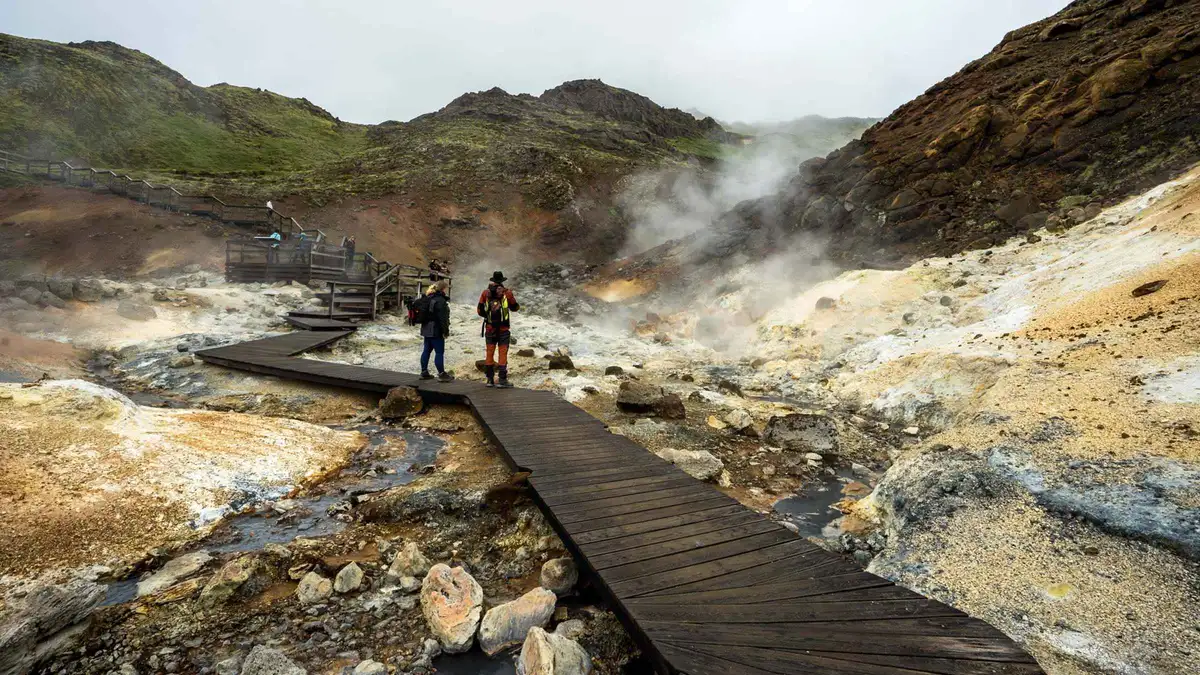
Hotel pickup Reykjavik: Volcanoes, Grindavik, Hot Springs and Lava Tour
The only tour here that goes into Grindavik itself and talks about what the eruptions did to the town. Hotel pickup is included and reviewers describe six-seat vans rather than coaches.
- Drives into Grindavik and past the damaged streets
- Iceland's youngest lava fields
- Geothermal stops on the same loop
- Hotel pickup and drop-off included
 from $114
Cheapest peninsula day
from $114
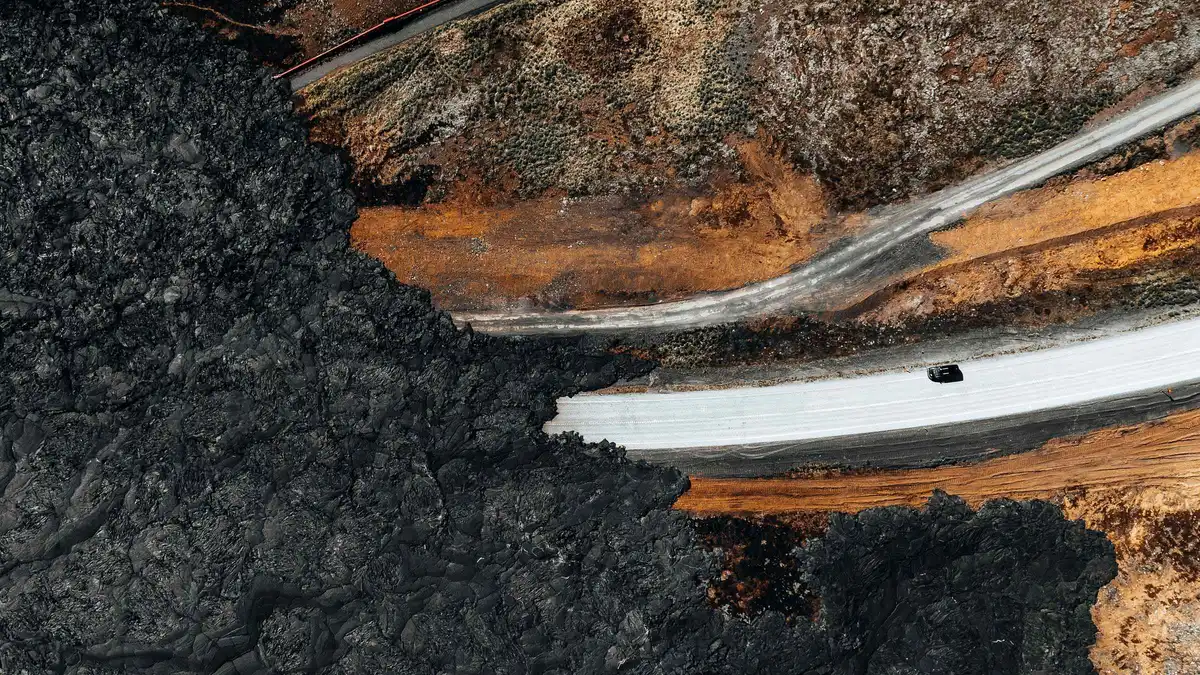
Cheapest peninsula day From Reykjavik: Volcanic Peninsula and Grindavik Minibus Tour
The most stops for the least money on the peninsula, in a minibus with pickup included. The walking is short, so this is the sightseeing version rather than a hike.
- Sundhnukagigar and Svartsengi lava field
- Natthagi viewpoint under Fagradalsfjall
- Kleifarvatn, Graenavatn and Seltun
- Pickup and drop-off in Reykjavik
 from $515
Aerial view
from $515
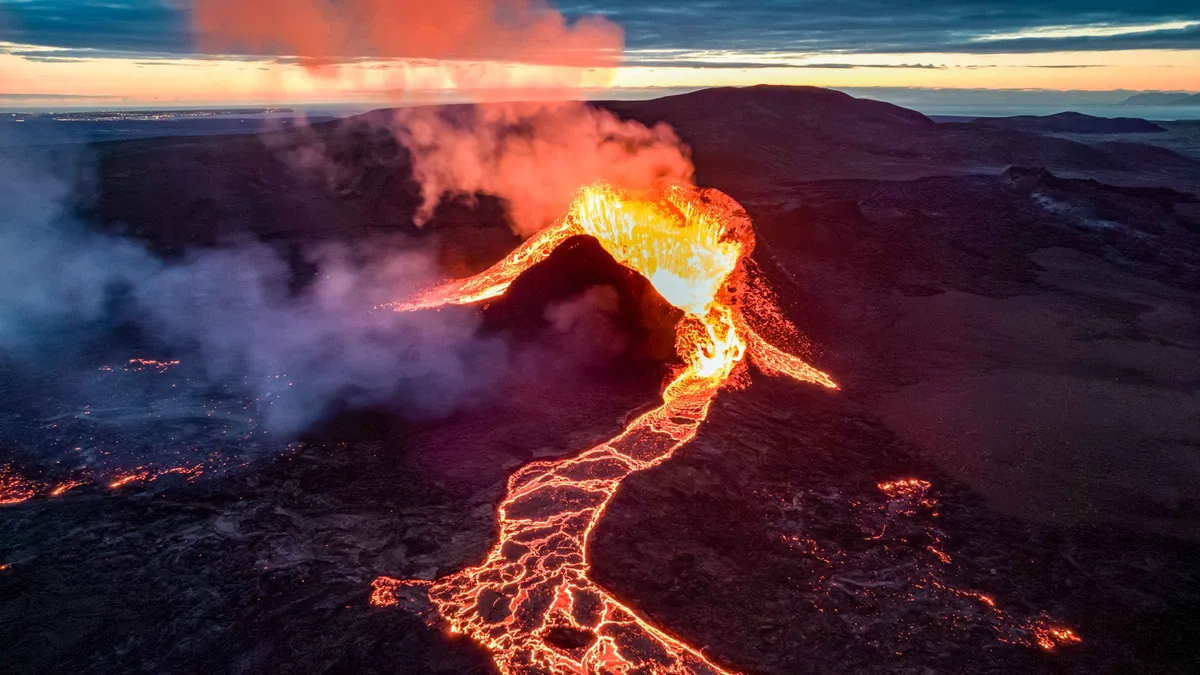
Aerial view From Reykjavik: New Volcanic Area Helicopter Tour
The fastest way to see the scale of the lava field, and the only one that does not depend on which trails are open. Four passengers are needed for the flight to go, and reviewers note flights sometimes run shorter than the 40 minutes advertised.
- 40-minute flight over the youngest lava on the peninsula
- Five participants maximum
- Full refund if weather or numbers cancel the flight
- Flights follow Civil Protection rules on the day
Who Decides What Is Open
Not the tour company, and that is the point.
Civil Protection Sets the Boundary
Access to an eruption site in Iceland is decided by the Department of Civil Protection and Emergency Management. When it closes an area, every operator reroutes, shortens or cancels, and the listings on this site say so in their own terms: one states plainly that the route it takes can change for safety reasons, another that it reserves the right to cancel if the authorities require it.
That is a better guarantee than any operator's safety page. A tour that promises you a specific crater before the morning briefing is promising something it does not control.
The Met Office Watches the Ground
The Icelandic Met Office monitors deformation, seismicity and gas, and publishes what it sees. Its current reading on Reykjanes is that the land at Svartsengi has risen about five centimetres over three months and that, while uplift continues, the most likely scenario is a magma intrusion propagating from Svartsengi into the Sundhnukur crater row.
An intrusion is magma moving sideways underground. It may or may not reach the surface. That distinction is the whole of Icelandic eruption forecasting, and no operator can improve on it.
ICE-SAR Publishes the Trail Warnings
Safetravel, run by the Icelandic Association for Search and Rescue, is where hiking conditions are published. Its current advice includes a warning that conditions on the Fimmvorduhals trail are dangerous and that people should not hike it while they remain so.
That warning has nothing to do with an eruption. It is the ordinary business of Icelandic hazard: weather, ice and ground conditions, on a route between two ice caps.
What the Real Hazards Are
Lava is the slowest and most visible of them, which is why it rarely hurts anyone.
Gas
Volcanic gas is what closes trails on days when the sky looks fine. It collects in hollows, it moves with the wind, and it does not announce itself. The operator notes on this site handle it the same way: the route changes when the wind carries gas over the trail.
The practical rule for visitors is to be with a guide who is listening to the forecast, or to check the official channels yourself before walking into an eruption area.
Water, Not Fire
Under the ice caps the bigger hazard is meltwater. A glacial outburst flood ran down Mulakvisl, which drains the eastern side of Myrdalsjokull, beginning on 18 August and taking about two weeks to subside, with the Met Office tracking conductivity and discharge and watching for gas along the river.
That is why ice cave tours cancel on clear mornings. The Met Office also warned this summer that the terminus of Solheimajokull had become unstable enough that rockfall and shifting ice were a risk to visitors.
The Ground Itself
Fresh lava fields are sharp, uneven and full of thin crust over voids. Every hiking listing here asks for moderate fitness for that reason, and the ones that do not are the coach tours that keep you on made ground.
None of this is exotic. It is the same set of risks as any mountain country, with the addition of gas.
The Numbers Worth Carrying
Four figures cover most of what a visitor needs. The emergency number is 112, with 599-0112 as the ICE-SAR backup after the 2G and 3G shutdown. The eruption area on Reykjanes lies about 30 km from Reykjavik, which is why day tours work and why the capital was never at risk. Every tour on this site cancels free up to 24 hours before departure.
And one more: 2010 is the only year in living memory when an Icelandic eruption closed European airspace, and it did so because it was an explosive eruption under ice. The 12 eruptions since 2021 have been lava at the surface, and none of them closed an airport.
Sources: Icelandic Met Office, Safetravel
What Happens to Flights
The 2010 question, asked by everyone with a ticket booked.
2010 Was Ash, Not Lava
The Eyjafjallajokull eruption in 2010 sent an ash cloud over Europe and closed airspace across the continent. It was an explosive eruption under ice, which is the combination that produces fine ash at altitude.
The Reykjanes eruptions since 2021 have been effusive: lava flowing at the surface, with little ash. They have not closed airspace, and Keflavik has kept operating throughout, which is the practical answer for anyone booking flights now.
What to Do About It Anyway
Nothing, beyond ordinary travel insurance. Icelandic airspace decisions are made by the aviation authorities using the Met Office's ash forecasting, and there is no traveller-side action that changes the outcome.
What is worth doing is building slack into the trip: a tour cancelled on day two can run on day four, and a flight missed on the last morning cannot be rescheduled at all.
What the Airport Record Shows
Since the Reykjanes sequence began in 2021, Keflavik has operated through every eruption. The closest any of them came to disrupting travel was the closure of the Grindavik road and the evacuation of that town, about 20 km from the airport, which affected residents rather than flights.
The ash risk that grounded aircraft in 2010 comes from explosive eruptions under glaciers, which is a different mechanism from a fissure opening in a lava field. Katla under Myrdalsjokull and Eyjafjallajokull are the systems capable of it, and neither has erupted since.
The Practical Rules
Four habits that cover almost everything.
Numbers and Checks
112 is the emergency number across Iceland, and ICE-SAR also publishes 599-0112 as a backup line after the 2G and 3G shutdown, which matters because older phones and some foreign SIMs lose access to the primary number. Save both.
Check Safetravel before hiking and the Met Office before driving into a volcanic area. Both publish in English and both are official rather than commercial.
Booking Habits
Book tours with free cancellation, which on this site means every listing: cancellation is free up to 24 hours before the start on all of them. Book the weather-dependent things early in your trip so a cancellation leaves you a second chance.
Keep an indoor fallback for the day the forecast turns. The Lava Show at $55 and the Raufarholshellir lava tunnel at $72 both run whatever the weather does.
Is Iceland Safe During an Eruption? Questions
Can I visit Iceland if a volcano is erupting?
Yes. Eruptions here are localised and the authorities close the affected area rather than the country. Access to an eruption site is decided by the Department of Civil Protection, not by tour operators.
Is it safe to go on a volcano tour?
On a guided tour, within whatever boundary the authorities have set, yes. The listings on the comparison all reroute or cancel when an area closes, and all cancel free up to 24 hours ahead.
Will an eruption affect my flight?
The 2010 closure was caused by an explosive ash eruption under ice. The Reykjanes eruptions since 2021 have been effusive lava events and have not closed airspace.
What is the biggest danger?
Volcanic gas, which moves with the wind and closes trails without warning. Under the ice caps the bigger hazard is meltwater flooding, which is what cancels ice cave tours.
Is anything erupting right now?
No. The Met Office reports continued uplift at Svartsengi, about five centimetres over three months, with a magma intrusion into the Sundhnukur crater row as the most likely next step.
What emergency number should I save?
112, and 599-0112 as the ICE-SAR backup line if 112 will not connect. Save both before you go hiking.
Can I walk to an eruption site on my own?
When one is open, yes, subject to the authorities' rules. There is no bus to any of these trailheads, which is the practical argument for the guided options on the Reykjanes page.