 Iceland Volcano Tour
Active Volcanoes in Iceland: What Each One Is Doing
The active volcanoes in Iceland are not a fixed list of cones but a set of systems along the rift that runs through the country, and at any moment most of them are doing nothing at all. Right now none is erupting: the Met Office reports about 5 centimetres of uplift at Svartsengi over 3 months and expects the next magma intrusion to run into the Sundhnukur crater row, while the uplift episode at Askja that began in 2021 has ended. This page goes through the ones visitors ask about, what each has done and whether there is a way to reach it. The tours are on Iceland volcano tour.
Quick answer What is erupting, what is watched, and what you can reach
Nothing is erupting in Iceland at the moment. The Met Office reports uplift at Svartsengi of about 5 centimetres over 3 months, with a magma intrusion into the Sundhnukur crater row as the most likely next step, and says the Askja uplift that began in 2021 has ended. The recent eruption record is 12 eruptions in 4 years on Reykjanes, 2010 at Eyjafjallajokull, 1973 at Eldfell, 1918 at Katla and 1783 at Laki.
Key takeaways
- The active zone you can walk on is Reykjanes: the tours there start at $114.
- The one you can go inside is Thrihnukagigur, dormant for over 4,000 years, open 5 May to 30 October.
- The one under ice is Katla, last erupted in 1918, visited through ice caves from $181.
- What the Met Office publishes and what it means for a booking is on is Iceland safe during an eruption.
Tours to the Systems That Have Erupted Most Recently
One walk on the 2021 to 2023 Reykjanes flows, one highland day to a caldera whose lava field dates from 2014, one ice cave on the volcano that last erupted in 1918, and one ride on the ice cap that closed European airspace in 2010. Figures current in Q3 2026.
 from $159
Highest rated hike
from $159
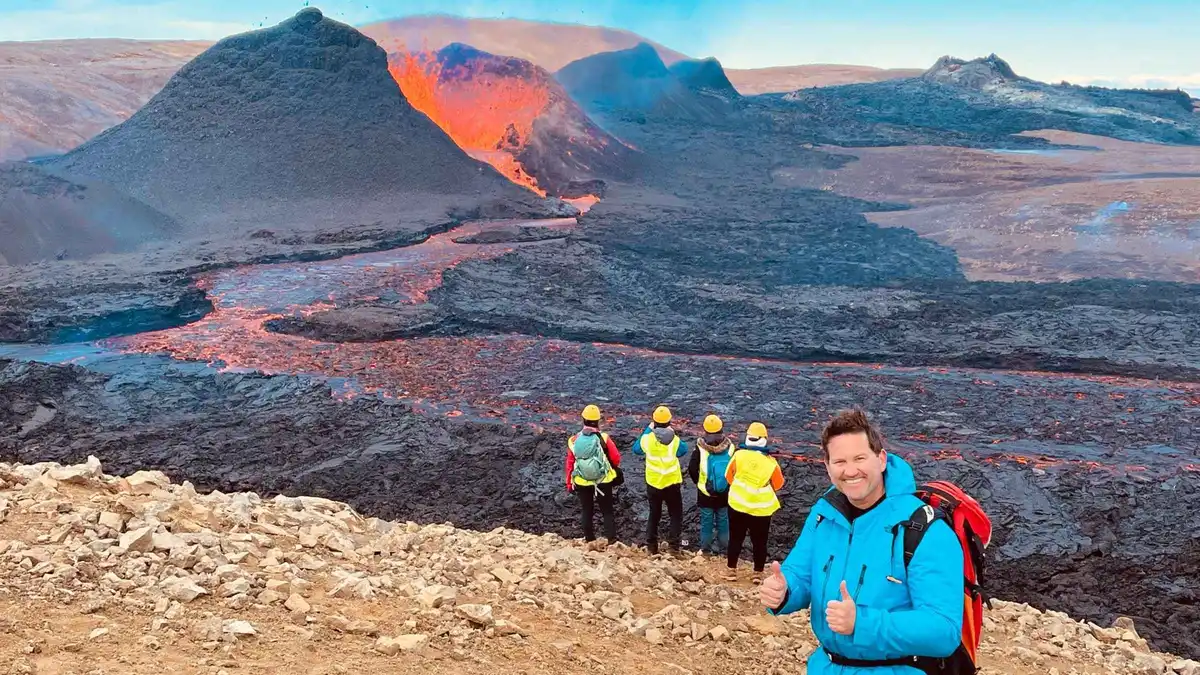
Highest rated hike Fagradalsfjall Volcano Hike: The Original Local Experience
The listing caps the group at 8 and gives 3.5 hours on the ground, the longest walking time of any Fagradalsfjall listing here. Pickup is from Geo Hotel Grindavik or Bus Stop 3 on Laekjargata, not from your hotel door.
- Group limited to 8 people
- 3.5 hours walking on the 2021-2023 lava
- Guides who worked the eruption from its first week
- Grindavik stop on the way in
 from $480
Highland caldera
from $480
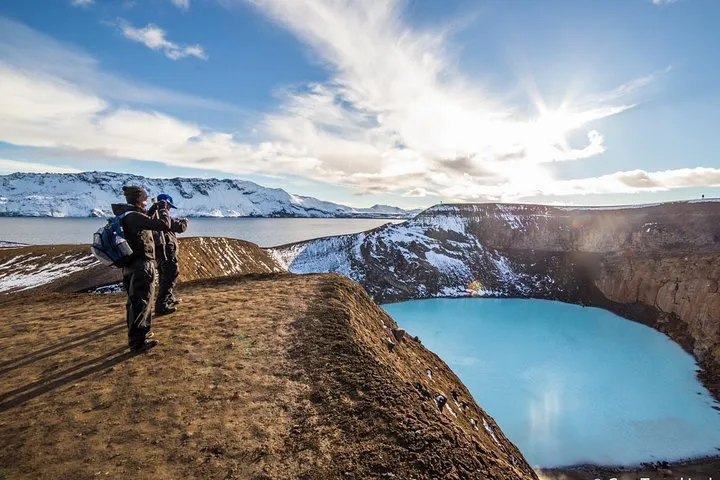
Highland caldera Askja and Holuhraun Super Jeep Day Tour from Lake Myvatn
The longest and most remote day on this list, and the only one that reaches a caldera you cannot drive to in a normal car. Bring your own food: there is no shop or restaurant anywhere on the route.
- Askja caldera and the Viti explosion crater
- Holuhraun, Iceland's largest lava field since 1783
- National park fees included
- Ten people maximum per booking
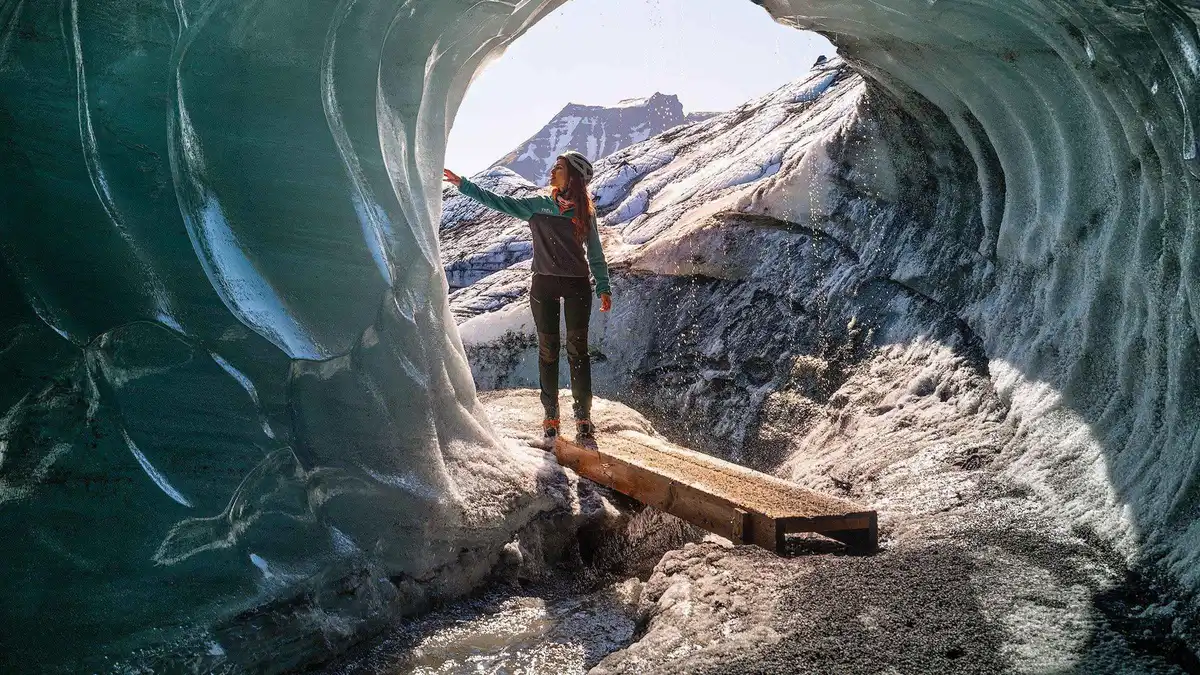
From Vik: Katla Ice Cave and Super Jeep Tour
The ice cave is inside the glacier that covers Katla, so this is the one tour on the list where you stand on an active volcano without seeing any lava. Crampons and helmets are provided and coffee waits in the jeep afterwards.
- Cancellation
- Free cancellation 24h
- Operator
- Troll Expeditions
 from $250
On the 2010 ice cap
from $250
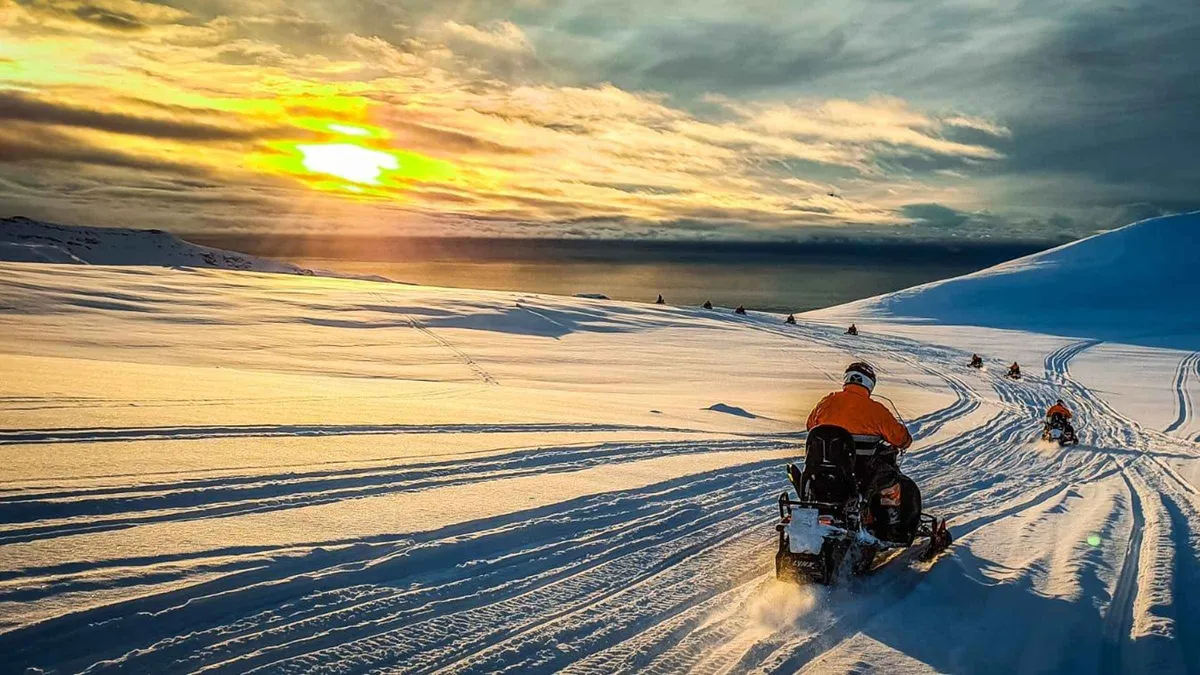
On the 2010 ice cap Snowmobiling on Eyjafjallajokull
The practical way onto the 2010 volcano, since the summit crater sits under a glacier and there is no walking route to it. Warm outdoor clothing and hiking boots are on you, not the operator.
- Snowmobile on the Eyjafjallajokull ice cap
- The volcano behind the 2010 airspace shutdown
- 35 minutes up by super jeep, an hour riding, 35 minutes back
- Driving licence needed to ride solo; passengers from age 6
Reykjanes: The One That Is Awake
Twelve eruptions in four years, 30 km from the capital.
Fagradalsfjall and Sundhnukur
Fagradalsfjall erupted in 2021, 2022 and 2023, and the Sundhnukur crater row north of it took over after that. One operator's own listing describes an area with 12 eruptions in the last 4 years, 30 km from Reykjavik, which is the plainest summary anyone has published.
The current state is not an eruption but a build-up: the Met Office reports the land at Svartsengi rising about five centimetres over three months and says that while uplift continues, the most likely scenario is a magma intrusion propagating from Svartsengi into the Sundhnukur crater row. An intrusion may or may not break the surface.
How to Visit
On foot, from $114 on the Grindavik minibus loop or $159 on the small-group Fagradalsfjall hike with 3.5 hours on the ground. From the air, $501 or $515 for 35 or 40 minutes, compared on the helicopter page.
What you see is cooled lava. The 2021 to 2023 flows are bare black rock with no moss yet, which is as close to a fresh eruption surface as anywhere in the country.
The Ones Under Ice
Katla, Eyjafjallajokull and Grimsvotn: the systems that make ash rather than lava rivers.
Katla
Katla sits under Myrdalsjokull and last erupted in 1918. It is the system whose meltwater the Met Office watches most closely: a glacial outburst flood ran down Mulakvisl on the eastern side of the ice cap beginning on 18 August and took about two weeks to subside.
You cannot see the volcano. What you can do is walk into the ice above it: the Katla ice caves from Vik run three hours from $181, with the black stripes in the ice being ash from past eruptions.
Eyjafjallajokull
The 2010 eruption sent an ash cloud over Europe and closed airspace across the continent, which is why this is the name everyone knows. It has not erupted since.
The summit is under a glacier and there is no walking route. The ways up are mechanical: a snowmobile on the ice cap at $250 or a super jeep up the slopes at $404. Both start from a base camp on the south coast rather than from Reykjavik.
The Highland Systems
Askja, Krafla, Hekla and Laki: the ones behind the F-roads.
Askja and Krafla
Askja's most recent eruption was in 1961, which built the Vikrahraun lava field, and its 1875 eruption threw ash far enough east to empty settlements in Jokuldalsheidi and push emigration to North America. Holuhraun beside it was laid down by the 2014-2015 eruption. The Met Office says the uplift episode that began in 2021 has now ended.
Krafla, further north, produced the Krafla Fires through the late 1970s and early 1980s. Neither is a ticketed site: Askja is a 12-hour super jeep day from Lake Myvatn, and the Krafla area is seen on six-hour loops from Akureyri at $182.
Hekla and Laki
Hekla is the volcano Icelandic chronicles return to most often, and no operator sells a tour to it alone. The listings that name it are Landmannalaugar superjeep days that pass it, from $446.
Laki erupted in 1783 along a crater row about 25 km long, and the gas killed pasture and caused famine. There is no road tour: the only listing that reaches it is a 50-minute flight from Skaftafell at $432.
Islands, Craters and the Dormant Ones
The systems that are quiet but visitable, which is the opposite of the rule elsewhere.
Eldfell on Heimaey
Eldfell erupted in 1973 on the edge of a working town. Over 5,000 people, the entire population, left overnight, and islanders pumped seawater onto the lava to protect the harbour.
It is the most visitable eruption site in the country because there is a town next to it: a coach loop at $123, a boat around the island at $103, and an electric scooter at $105.
Thrihnukagigur and the Craters
Thrihnukagigur has been dormant for over 4,000 years, which is precisely why you can be lowered 120 metres into its chamber. The season runs 5 May to 30 October and the ticket bought direct is ISK 51,000 ($418.83).
Kerid is about 6,500 years old, 55 m deep, and costs 700 ISK ($5.75) at the gate. Hverfjall in the north is one of the largest tephra craters on earth and is free to climb. Neither is going to do anything, which is what makes them the reliable stops on a volcano itinerary.
Active Volcanoes in Iceland: Questions
How many active volcanoes are there in Iceland?
The country is built on a rift with many volcanic systems, and the useful question is which are doing something. Right now the answer is none: the Met Office is watching uplift at Svartsengi rather than an eruption.
Which volcano is erupting in Iceland now?
None. The most likely next event is a magma intrusion from Svartsengi into the Sundhnukur crater row, which may or may not reach the surface. Details on the Reykjanes page.
Which active volcano can I get closest to?
The Reykjanes flows, which you can walk on from $114. For the inside of one, Thrihnukagigur is the only accessible magma chamber on earth, and it has been dormant for over 4,000 years.
Is Katla overdue?
Katla last erupted in 1918, and talk of it being overdue is a pattern read into an irregular record. What the Met Office actually tracks there is meltwater and seismicity, not a schedule.
Which eruption affected flights?
Eyjafjallajokull in 2010, because it was explosive and under ice. The Reykjanes eruptions since 2021 have been lava at the surface and have not closed airports.
Can I visit Hekla?
Not on its own. The listings that reach it pair it with Landmannalaugar by superjeep, from $446, described on the Hekla page.
What is the biggest eruption in Icelandic history?
Laki in 1783 by consequence: a 25 km fissure, months of lava, gas that poisoned pasture and a famine that followed. It is reachable only by air.