 Iceland Volcano Tour
Lava Tunnel Iceland: The Raufarholshellir Guide
A lava tunnel Iceland trip usually means Raufarholshellir, a 5,200-year-old lava tube about half an hour east of Reykjavik and one of the longest in the country. This page compares the three ways to do it: a self-drive ticket, a coach transfer from the BSI bus terminal, and a version that also collects cruise passengers at the port. We set out what the hour underground actually involves, what the cave does not offer, and who should stay on the surface. No operator runs this site. We compare listings and report what they say about themselves.
Quick answer Lava tunnel Iceland at a glance
The standard lava tunnel Iceland tour at Raufarholshellir costs ISK 8,900 at the door, runs one hour underground and departs from a site open 9:00 to 17:00. Tickets with coach transport from Reykjavik cost $120 to $146. The cave formed in the Leitahraun eruption about 5,200 years ago.
Key takeaways
- Compare all three lava tunnel listings side by side before you book.
- See the full price and transport comparison between self-drive and transferred tickets.
- Check who should not go down, including wheelchair users and anyone with back or knee problems.
- Not set on a cave? An indoor lava show is the warm alternative.
Lava Tunnel Iceland Tours Compared
The listings here all cover the same cave, Raufarholshellir, and all include the one-hour guided walk underground with helmet and lights. None of them includes lunch, drinks or good hiking shoes, and only two include transport from Reykjavik. The self-drive option is the cheapest but you need your own car on road 39. The transfer options leave from the BSI bus terminal, and one of them also picks up at the cruise port. Ratings and review counts come from the listings themselves. Figures current in Q3 2026.
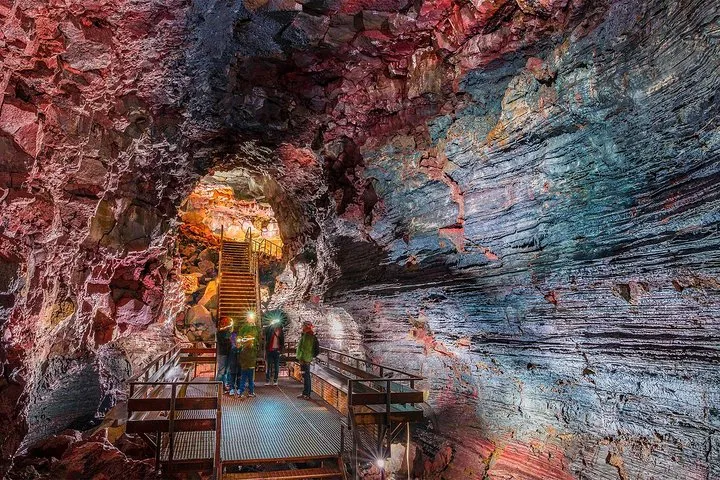 from $72
Cheapest lava
from $72
Cheapest lava The Lava Tunnel Tour, Raufarholshellir
The lowest price on this page and the only volcano interior open all year. You drive yourself: the ticket covers the guide, helmet and lights, not transport from the city.
- Walkway through a 5,200-year-old lava tube
- Helmet and lights included
- Open year-round, 30 minutes from Reykjavik
- Six departure times a day
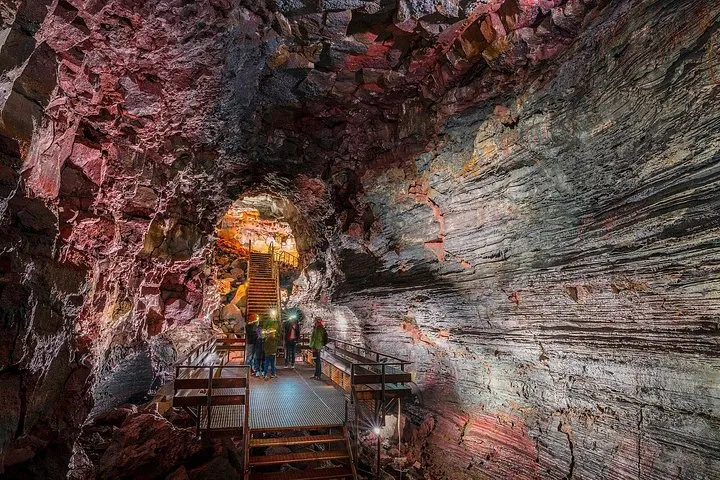 from $120
No car needed
from $120
No car needed The Lava Tunnel Tour with Transfer from Reykjavik
Sold by the tunnel itself, with the coach run by Reykjavik Excursions from BSI. Helmet, headlamp and, in winter, crampons are included. Good hiking shoes are not.
- Lava tunnel tour with return transfer from BSI
- Helmet, headlamp and walking sticks provided
- Crampons issued in winter
- Three hours in total
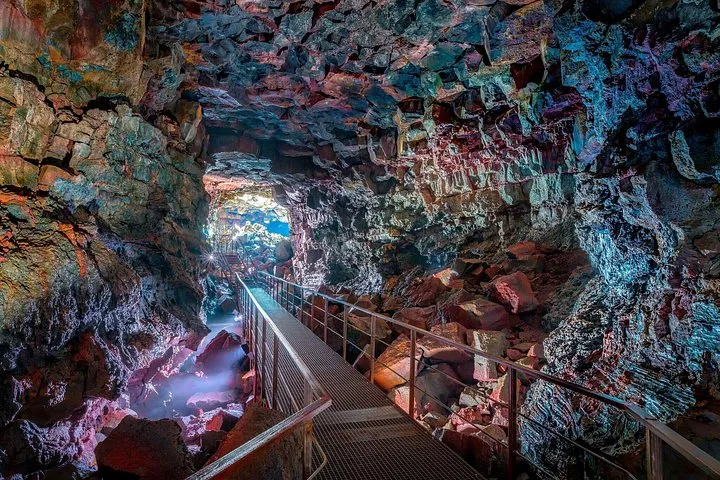 from $146
Cruise pickup
from $146
Cruise pickup Lava Tunnel Tour Including Transfers from Reykjavik
The one lava tunnel listing that collects cruise passengers at the port. Minimum age is three and the guide travels with the bus rather than meeting you at the cave.
- One-hour guided cave tour plus bus fare
- Cruise port pickup available
- Helmet and flashlight provided
- Minimum age 3
Price And Transport Comparison
The table below puts the three lava tunnel Iceland listings next to each other so you can see what the extra money for a transfer actually buys. Prices are the listed tour prices in dollars, durations are the total time the operator quotes, and the departure points are as printed on each listing.
| Tour | What you get | Time | Book | Leaves from | Price |
|---|---|---|---|---|---|
| Self-drive ticket | 1 hour guided, helmet and lights | 1 hour | Check Availability | Road 39 towards Thorlakshofn | $72 |
| Coach from BSI | 1 hour guided, helmet, headlamp, sticks, winter crampons | 3 hours | Check Availability | BSI Bus Terminal, Reykjavik | $120 |
| Coach plus cruise port pickup | 1 hour guided, helmet, flashlight, guide travels on the bus | 3 hours | Check Availability | BSI Bus Terminal or cruise port | $146 |
What Raufarholshellir Actually Is
The facts of the cave, as measured and published by the site itself.
A 5,200-Year-Old Lava Tube
Raufarholshellir formed during the Leitahraun eruption about 5,200 years ago, east of the Blafjoll mountains. Molten lava kept flowing under a hardened crust, and when the flow drained the pipe it left behind stayed empty. What you walk is the path the lava took.
It is one of the longest lava tubes in Iceland. The tour follows a section of it with a footbridge and fixed lighting through the first part, so you are not scrambling in the dark. In winter, ice sculptures form at the entrance, which many visitors say is the best reason to come in the cold months.
One listing also notes that scenes from the film Noah were shot in the cave, which tells you something about the scale of the chambers.
| Fact | Detail |
|---|---|
| Formation | Leitahraun eruption, about 5,200 years ago |
| Location | East of the Blafjoll mountains, about 30 minutes from Reykjavik |
| Tour duration | 1 hour underground |
| Opening hours | Open 9:00 to 17:00 |
| Standard ticket | ISK 8,900 |
| Season | Open year-round |
What You Will And Will Not See
You will see the inside of a genuine lava tube, the walkway and lighting through the first section, and ice formations at the entrance in winter. The guide explains how the tube formed as the lava drained.
You will not see lava. No eruption is flowing at the time of writing anywhere on the Reykjanes peninsula, and Raufarholshellir has been cold rock for five millennia. Listing photographs sometimes show fountains from current eruptions, but those are separate events elsewhere on the peninsula and not part of this tour.
The listing does not state how far into the tunnel the tour walks or how much of the total tube length is open to visitors, so plan on the hour quoted rather than any distance. If you want molten lava indoors instead, the lava show in Reykjavik pours real lava in a theatre setting.
Sources: The Lava Tunnel
Getting There And What It Costs
Three ways in, three prices, and the difference is almost entirely about transport.
Driving Yourself
The tunnel is 30 to 40 minutes from Reykjavik by car. Take road 1 east for about 18 km, then turn right onto road 39 towards Thorlakshofn. The self-drive ticket at $72 covers the guide, helmet and lights only. Getting there is your problem, and in winter the roads around Blafjoll can be icy.
At the door, the standard tour costs ISK 8,900. The site is open 9:00 to 17:00 and runs six departure times a day. The weather does not matter. The tour is indoors and runs whatever the weather does, which makes it one of the few volcano-related activities in Iceland that no storm can cancel.
| Option | Price | Total time | Departs | Kit included |
|---|---|---|---|---|
| Self-drive (tour-8) | $72 | 1 hour | Road 39, drive yourself | Helmet and lights |
| Transfer from BSI (tour-28) | $120 | 3 hours | BSI Bus Terminal, Reykjavik | Helmet, headlamp, sticks, winter crampons |
| Transfer with cruise pickup (tour-29) | $146 | 3 hours | BSI or cruise port, pickup 30 minutes early | Helmet and flashlight |
Going By Coach
Two of the listings add a return coach from Reykjavik. The $120 version is sold by the tunnel itself with the coach run by Reykjavik Excursions from the BSI bus terminal. It takes three hours in total, still with one hour underground. Helmet, headlamp and walking sticks come with the ticket, and crampons are issued in winter. Good hiking shoes are not, so bring your own.
The $146 version is run by Reykjavik Excursions and is the only one that collects cruise passengers at the port. Pickup at the BSI terminal or the port starts 30 minutes before departure, and the guide travels with the bus instead of meeting you at the cave. Minimum age is 3. If your ship docks in Reykjavik, this is the only listing built for you.
The $48 to $74 premium over the self-drive ticket buys the coach seat and nothing else underground. The cave visit is identical on all three.
Tickets, Promo Codes And Finding The Site
Tickets for the lava tunnel Iceland tours are sold through Viator and directly at the site, where the standard tour is ISK 8,900. All three listings on this page offer free cancellation up to 24 hours before the start, so booking ahead costs little risk. None of the listings we compared publishes a promo code, and we do not repeat discount claims we cannot verify. Check the price on the listing itself rather than hunting for a code, because the self-drive ticket at $72 is already the cheapest route in.
For the map question, the practical answer is road 39 towards Thorlakshofn, about 18 km east of Reykjavik on road 1 and then right. The tunnel sits in the same corner of the Reykjanes peninsula as the Fagradalsfjall volcano tours and the wider Reykjanes volcano tours area, so many drivers combine a cave morning with an afternoon on the lava fields. If you are staying in the city and have no car, the transfer options from Reykjavik are the realistic route.
Sources: The Lava Tunnel
What The Hour Underground Is Like
An honest account of the one hour, drawn only from what the listings themselves state.
The Walk Itself
Every listing quotes the same core: one hour underground with a guide. The ground is uneven throughout, and the self-drive listing is explicit that the route involves steep stairs. The transfer listing describes the difficulty as suitable for all fitness levels, which is the operator's claim rather than ours, but both agree the cave is cold. Dress warmly and wear sturdy footwear no matter which ticket you hold.
Lighting and a footbridge carry you through the first part of the tunnel, so the opening section is easy going. Beyond that the listings do not describe the route in detail, and we will not guess at distances or walking times they do not publish. Six departure times a day are offered, so you can fit the hour around other plans.
Winter changes the character of the entrance. Ice sculptures build up where cold air meets the cave mouth, and crampons are issued on the BSI transfer listing in winter. The cave stays cold all year regardless of the weather above.
Who Should Not Go Down
The honest limits first. Raufarholshellir is not wheelchair accessible. It is not recommended for people with back or knee problems, and the steep stairs and uneven ground are the reason. One listing sets a minimum age of 3 while another is not recommended under 3, so families with toddlers should read the specific ticket before booking.
The cave is not affected by the eruption situation on the Reykjanes peninsula in the way surface hikes are. The Icelandic Met Office reports continued uplift at Svartsengi, and while uplift continues the most likely scenario stays a magma intrusion towards the Sundhnukur crater row. That can close trails and eruption sites on the surface, decided by the Department of Civil Protection and Emergency Management rather than by any operator. An underground tour on road 39 is a different activity and does not depend on those decisions, though road closures in the area are always possible.
If the cave does not suit you, the descent into Thrihnukagigur is a different kind of interior visit, and a volcano helicopter tour keeps you above ground entirely.
When To Go
The cave runs all year, but winter and summer visits are not the same experience.
Winter Versus Summer
Raufarholshellir is the only volcano interior on this site that is open year-round. Summer visits are straightforward. The road is dry, the 30 to 40 minute drive from Reykjavik is easy, and the cave offers a cool hour out of the sun.
Winter is when the cave earns its reputation. Ice sculptures form at the entrance as freezing air moves through the tube, and the BSI transfer listing issues crampons when the ground outside is icy. The self-drive option becomes more demanding, because road 39 in winter needs a properly equipped car and confident driving.
The practical advantage of any winter visit is cancellation proof. The tour runs whatever the weather does because it is underground, which cannot be said for the surface hikes at Fagradalsfjall or the highland caldera trips to Askja and Landmannalaugar. For packing, our what to wear page covers the layers that matter, and the same warm boots that suit a lava field hike suit the cave.
How A Lava Tube Forms
Raufarholshellir was made by flowing lava, not by water or erosion. Here is the plain version of how it happened.
A River Of Molten Rock Under Its Own Crust
When the Leitahraun eruption began about 5,200 years ago, east of the Blafjoll mountains, lava poured across the ground in a fast-moving stream. The surface of that stream cooled first and hardened into a crust, the way a kettle of fat skins over while the middle stays hot. Below the crust the lava kept flowing for weeks, and the moving liquid slowly carved a smooth channel for itself. When the eruption ended, the supply stopped and the molten rock drained away down the channel, leaving behind an empty pipe. That pipe is a lava tube. Raufarholshellir is one of the longest lava tubes in Iceland, and the tour route follows the exact path the lava took on its way downhill. What you walk is therefore the old plumbing of the eruption, still carrying the shapes the flow left behind: smoothed walls, ledges where the lava level sat, and the tunnel ceiling above your helmet.
This is different from most caves people know. A limestone cave is dissolved out drop by drop over millions of years. A lava tube is built and emptied in a single eruption, which is why the interior looks sculpted rather than eroded.
Why The Entrance Area Looks Different In Winter
A lava tube behaves like a cellar. The rock holds a steady cold temperature, and air moving through the tunnel freezes whatever moisture sits near the openings. At Raufarholshellir that shows up as ice sculptures at the entrance in winter, a feature the site itself lists alongside the walkway and lighting. The first part of the tunnel is developed for visitors, with a footbridge underfoot and fixed lighting overhead, so the start of the tour is straightforward even for people who have never been in a cave. Farther in, the ground stays uneven and the helmet and lights issued with every ticket do real work.
None of this depends on the weather outside or on what the Department of Civil Protection has open, because there is no live volcanic activity involved. The tunnel runs all year, every day from 9:00 to 17:00, whatever the sky is doing. That reliability is the main reason a lava tunnel suits travellers with one fixed day in the capital area. For the wider set of underground and eruption-site options, the Iceland volcano tour homepage lists them side by side.
Driving Out On Road 39
The cheapest ticket assumes you have a car. The drive is short and the directions are simple.
The Route From Reykjavik
The tunnel sits 30 to 40 minutes from Reykjavik. The route is road 1 east for about 18 km, then right onto road 39 towards Thorlakshofn. That is the whole journey, and the listing for the self-drive Lava Tunnel Tour repeats the same instruction on its ticket page. There is no coach to meet and no pickup window to watch, so you choose which of the six daily departures suits you and arrive before it. The site is open 9:00 to 17:00.
Fuel, parking and car rental are not covered by the ticket, and the pack does not state parking fees or car park details, so check those directly with the site if it matters to your budget. What the ticket does include is the guide, a helmet and lights. Walking sticks are optional and can be added. The standard tour costs ISK 8,900 and the listing shows $72, which is the lowest price of the three lava tunnel options compared on the tours section of this page. Cancellation is free up to 24 hours before the start, which matters in winter when the roads around Reykjavik can turn quickly. Because the visit is underground, it runs whatever the weather does, so a storm outside does not cost you the booking. Wear shoes with a grip, since the ground inside is rough in places and the stairs are steep.
What Is At The Site
The developed part of the tunnel has a footbridge and lighting through the first section, so the entry and exit are the easiest ground on the route. Helmets and lights come with every ticket and are issued before you go down. In winter the entrance area holds ice formations, and one listing adds crampons to the kit when conditions call for them.
Facilities beyond the tunnel itself, such as a cafe or shop, are not stated in the material reviewed here, so do not count on buying food on site. Plan for the cold regardless of season, because the cave keeps its own temperature and stays chilly in summer too. The one-hour route is not wheelchair accessible and is not recommended for people with back or knee problems. One listing sets a minimum age of 3, another is simply not recommended under 3, so parents should read the ticket they book closely. If you would rather leave the driving to someone else, the two transfer options from the BSI terminal are compared in the price section of this page.
Other Ways To Stand Inside Volcanic Rock
Raufarholshellir is not the only interior you can visit. The experiences differ more than the photos suggest.
The Four Kinds Of Interior
Iceland offers four distinct ways to get inside volcanic ground, and they suit different trips. A lava tube such as Raufarholshellir is a horizontal walk on an uneven floor, one hour long, open all year, 30 to 40 minutes from the city. The descent into Thrihnukagigur goes down inside the magma chamber of a volcano that last erupted thousands of years ago, which is a vertical trip rather than a walk. The Katla ice caves take you under the Myrdalsjokull glacier at the edge of the volcano, so the visit mixes rock and ice and depends on cave conditions. Lava shows, covered on the lava show page, pour actual molten lava indoors in a seated venue, so you see liquid rock at close range without walking anywhere.
Add the outdoor sites and the list grows. Kerid is a crater lake you can walk around, the Reykjanes eruption areas near Grindavik offer hikes on cooled lava when the Department of Civil Protection has them open, and Askja and Viti sit in the highlands. Each of these is a different Iceland volcano tour, not a variation on the same one.
Where The Lava Tunnel Wins, And Where It Does Not
Raufarholshellir is the easiest and most dependable of the interiors. It runs in all weather, all year, costs $72 for the basic ticket, needs no fitness beyond steady footing, and takes about half a day out of a Reykjavik stay including the drive. Scenes from the film Noah were shot in the cave, which tells you something about the scale of the chamber.
What it does not give you is depth or heat. You stay on a lit walkway for an hour, so there is less sense of expedition than the Thrihnukagigur descent, and no molten rock at all, unlike a lava show. If you want to stand inside a volcano's plumbing, this is the straightforward version of it. If you want the vertical thrill, compare the Inside the Volcano page before booking. Prices, durations and ratings for all three tunnel tickets sit in the comparison table earlier on this page, so you can weigh the self-drive option against the two coach transfers in one view.
Which Ticket Should You Book
If You have a rental car and want the lowest price
Book the $72 self-drive ticket and take road 39 towards Thorlakshofn yourself.
If You have no car and want winter crampons and walking sticks included
Book the $120 coach tour from BSI, which runs three hours door to door.
If You are arriving on a cruise ship
Book the $146 listing with cruise port pickup, the only one that collects at the port.
If You travel with a toddler under 3
Read carefully: one listing is not recommended under 3 and the other sets a minimum age of 3, so neither is a clear fit.
If You use a wheelchair or have back or knee problems
The tunnel is not accessible and not recommended for you, so consider an indoor lava show instead.
Lava Tunnel Iceland Questions
Is the lava tunnel in Iceland worth it?
For the price of a self-drive ticket at $72 you get a guided hour inside one of the longest lava tubes in Iceland, with helmet and lights included, and it runs whatever the weather does. If you expect lava, you will be disappointed, because the tube has been cold rock for about 5,200 years. Our comparison table shows what each ticket includes.
How long is the lava tunnel tour?
The guided tour underground lasts one hour. The transfer versions from Reykjavik take three hours in total including the coach, and the tunnel itself is open 9:00 to 17:00 with six departures a day. Details are in our getting there section.
Are there lava tunnels in Iceland?
Yes. Iceland has many lava tubes, and Raufarholshellir is one of the longest, formed in the Leitahraun eruption about 5,200 years ago east of the Blafjoll mountains. It is the best known lava tunnel Iceland offers visitors and the subject of this full guide.
How do I get to Raufarholshellir from Reykjavik?
Drive road 1 east for about 18 km, then right onto road 39 towards Thorlakshofn, which takes 30 to 40 minutes. Without a car, the coach tours leave from the BSI bus terminal and take three hours return.
Who should not visit the lava tunnel?
The tunnel is not wheelchair accessible and is not recommended for people with back or knee problems, because the route has uneven ground and steep stairs. Age rules differ between listings, with one setting a minimum age of 3. We cover all the limits in who should not go down.
Does the lava tunnel tour run in winter?
Yes, it is open year-round and runs whatever the weather does because it is underground. In winter, ice sculptures form at the entrance and the BSI transfer listing issues crampons. Pack for the cold using our what to wear advice.